Mood
Mood is a mood tracker: one word for how a day went, in your own words, and a whole year of them drawn as a grid of coloured squares.
- Mark todayTap a word on the card above the grid.
- Mark today, on a phoneThe + button fans out every word you keep.
- Mark another dayTap its square and pick from the words you keep.
- Use your own wordsRename any of the five waiting, or add your own.
- Turn the year roundLayout. Horizontal at a desk, Vertical on a phone.
- Miss a dayNothing happens. A day nobody marked stays blank.
One word a day
Mood is the simplest tracker in Planye: a single word for how a day went, and a colour to go with it.
Five starter words are offered until you answer them: Happy, Good, Steady, Low, Tired. Tap one to keep it, or its cross to stop it being suggested. They're a starting point rather than the vocabulary, so rename any you keep, or write your own alongside.
your words, not five moods everyone gets handed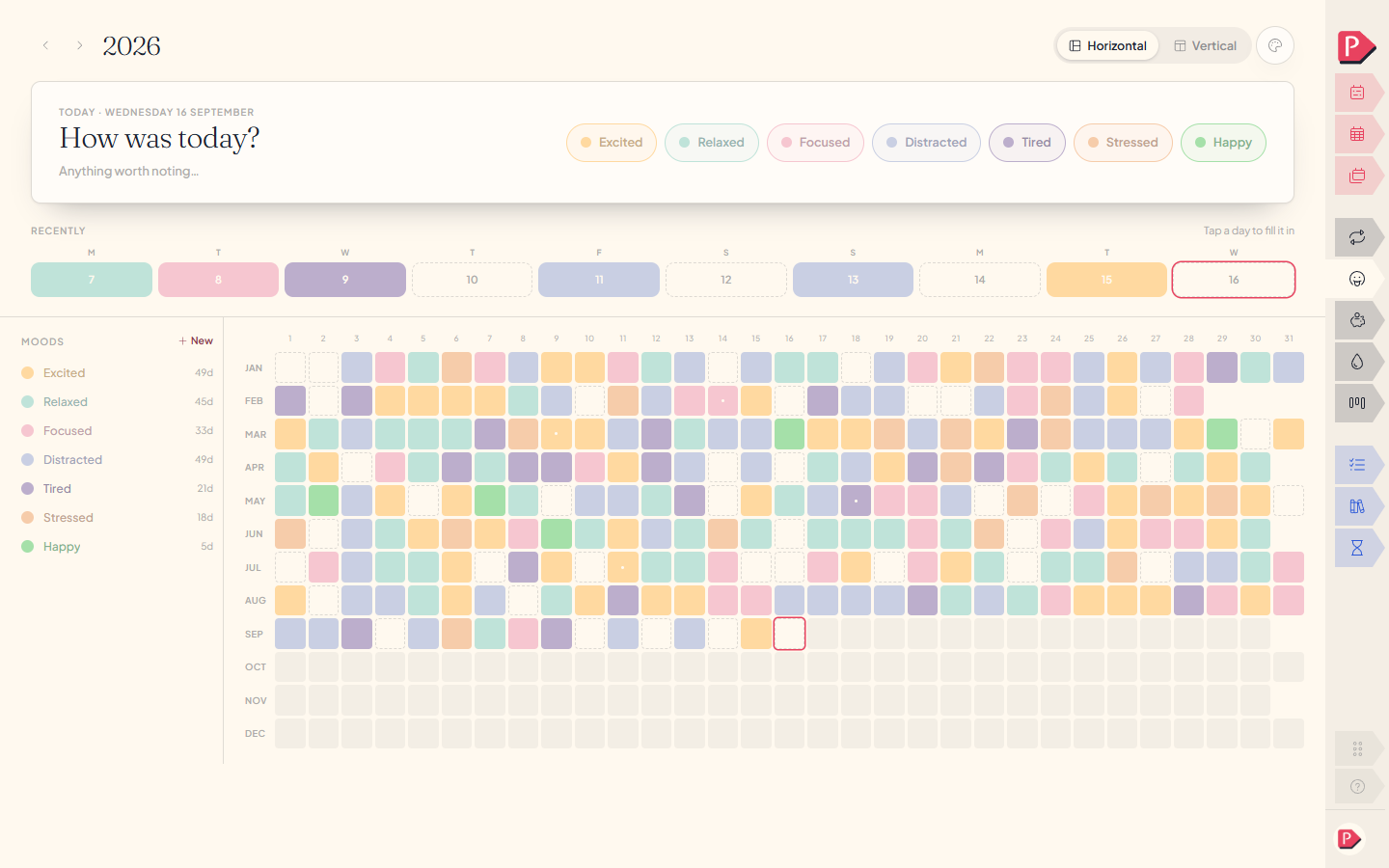
Marking a day
Today has its own card above the grid, asking straight out, "How was today?", so you never go hunting for the right square.
Marking today from its own card
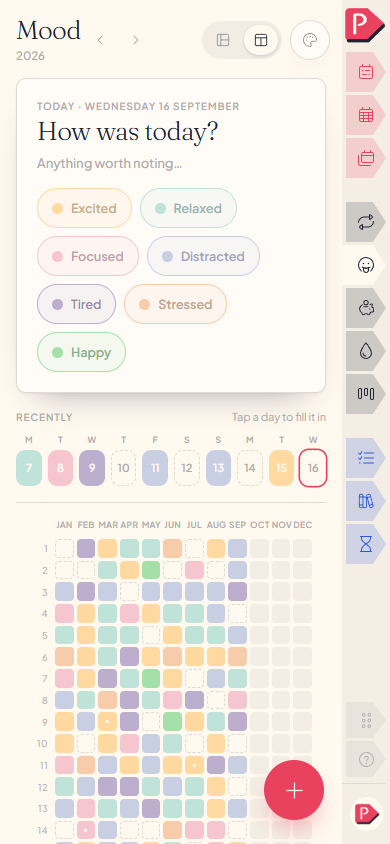
Marking today from its own card, on a phone
A Recently strip sits under today's card, the last few days as a row of squares. It is the quickest way to catch up a day or two you missed without hunting through the grid.
Filling in a recent day from the strip
Filling in a recent day from the strip, on a phone
For any other day, tap its square in the grid and a small picker opens beside it, listing every mood you keep as a coloured pill. A day already wearing one has a "Take it off" row at the foot of the same picker.
Filling in an older day straight from the grid
Filling in an older day from the grid, on a phone
A year of days, at a glance
Every day in the year sits in one grid, a square each, the layout people call a year in pixels:
- Filled a day you marked, in its mood's colour.
- Dashed a day behind today that's still blank, waiting.
- Pale a day still to come, which can't be marked yet.
The two layouts: Horizontal and Vertical
The Layout toggle turns the year round. The same days either way, read in a different direction:
- Horizontal lays the months down the side with the days running across, twelve long rows. It's the shape a wall planner has, and it wants width.
- Vertical turns the months into columns, so the year runs down the page and fits a phone with no sideways scrolling at all.
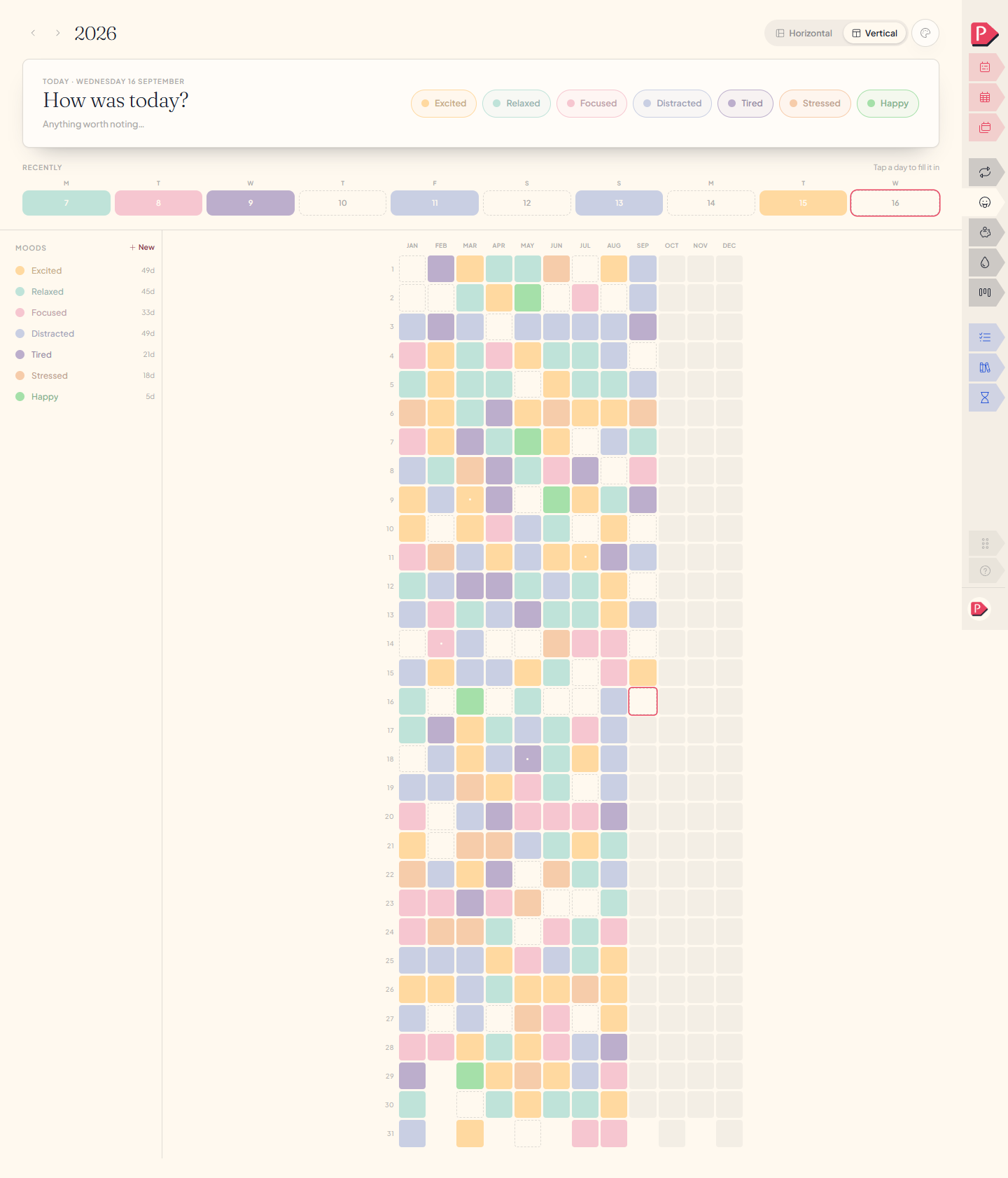
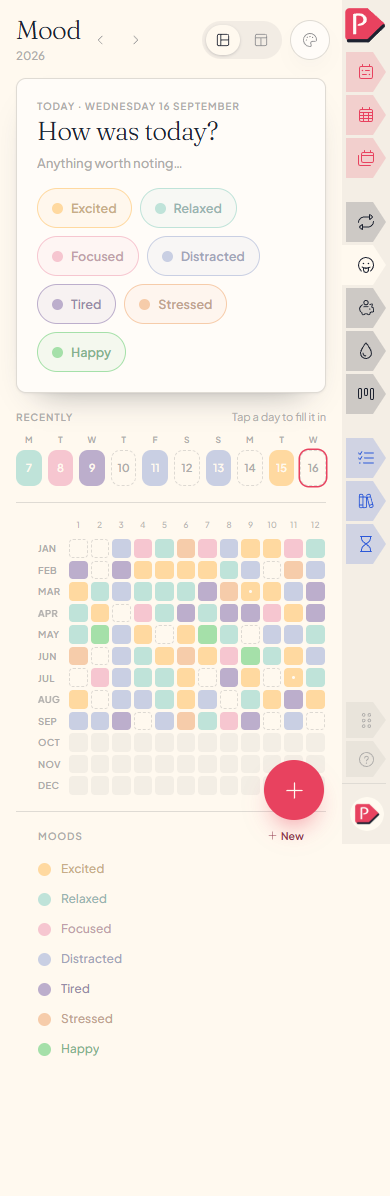
Until you touch it, Planye picks by screen width: Horizontal at a desk, Vertical on a phone. Pressing either segment makes it your account's choice on every device, and the Cycle grid follows the same one.
Until you touch it, Planye picks by screen width: Horizontal at a desk, Vertical on a phone. The toggle is two small marks at the right of the title, beside the arrows: rows for Horizontal, columns for Vertical. Pressing either makes it your account's choice on every device, and the Cycle grid follows the same one.
Switching the year grid between horizontal and vertical
Switching the year grid between horizontal and vertical, on a phone
Adding and renaming your mood words
Every mood you keep is listed beside the grid (below it on a phone), each with its colour, its name, and how many days are marked with it. Click a name to rename it in place, and + New adds another: a name, a colour, Add.
Adding a mood word of your own
Adding a mood word of your own, on a phone
Removing one takes the colour off every day marked with it, and those days go back to unmarked.
Questions about mood
The details, for when you want them. Nothing here is required reading.Can a day have more than one mood?
No, one word per day. Picking a new mood replaces the old one, so the grid stays a single colour per square, which is what makes a whole year of it readable in one look.
What if I forget to log a day, or a whole week?
Nothing. An unmarked day stays dashed and waits. There's no streak to break and nothing that reads a gap as a failure.
Mark it whenever you get to it, or never. Both are a fine way to use this page.
What happens if I remove a mood word?
Every day marked with it goes back to unmarked. Nothing is counted against you, and nothing records that the day used to have a colour.
What's the point of logging a mood at all?
One day tells you about that day. A month of them laid out together tends to tell you something you couldn't see one day at a time: a pattern around a person, a project, a stretch of short nights.
Nothing here scores a mood as good or bad, which is what makes logging the true one cost nothing.
How is this different from rating a day?
A rating is a number out of ten, kept under the month's plan. A mood is a word. One says how much, the other says what kind, and neither is required for the other.